
PowerSmartCoat
What Can PScoat Really Do?
PScoat is not an ordinary wall paint. It is a thermally active functional coating whose effect cannot be explained by film thickness alone.
That’s why we don’t just show product claims — we show measurements on real building elements, controlled test set-ups and completed buildings.
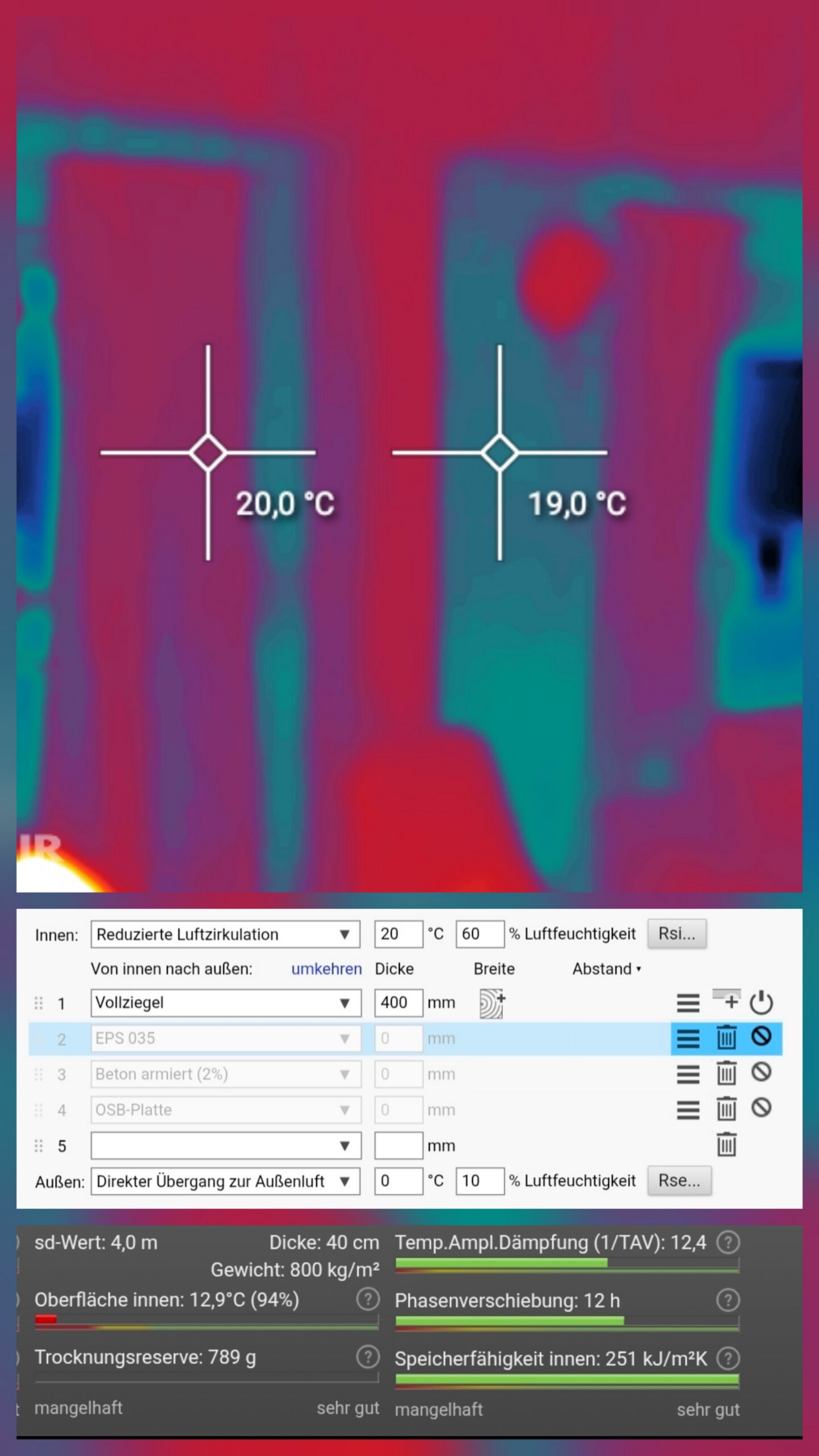
Interior wall surface under comparable measurement conditions – before and after coating.
It isn’t thickness alone that decides — it’s the thermal behaviour of the whole building element.
With classic homogeneous insulation, thermal performance can largely be described by thermal conductivity and film thickness. With a functional coating, by contrast, several physical effects can act together. What matters, therefore, is the measurable change in thermal resistance under defined boundary conditions.
That’s exactly where our investigations start: we look not just at the material on paper, but at the behaviour of the finished building element.
Physical fundamentals
Which effects can contribute to the thermal performance?
PScoat is not a homogeneous block of insulation material. The thermal performance of a functional coating can arise from the interplay of several physical properties.
-
01
Thermal conduction
The coating’s microstructure affects heat transfer and heat flow within the layer.
-
02
Thermal radiation
Surface properties such as emissivity affect radiative exchange at the building element’s surface.
-
03
Heat transfer
The properties of the interfaces can affect heat transfer between the surface and the surrounding air.
-
04
Microstructure
Embedded microparticles and hollow structures set the coating apart from an ordinary homogeneous paint.
What matters, therefore, is not a theoretical look at a single effect, but the measurable thermal behaviour of the whole building element.
Recent in-situ measurement
A real PScoat wall. Measured for almost 12 hours.
On 6–7 September 2026, an actual PScoat-coated wall was continuously logged for nearly twelve hours using a Testo 635-2 with a U-value measurement kit.
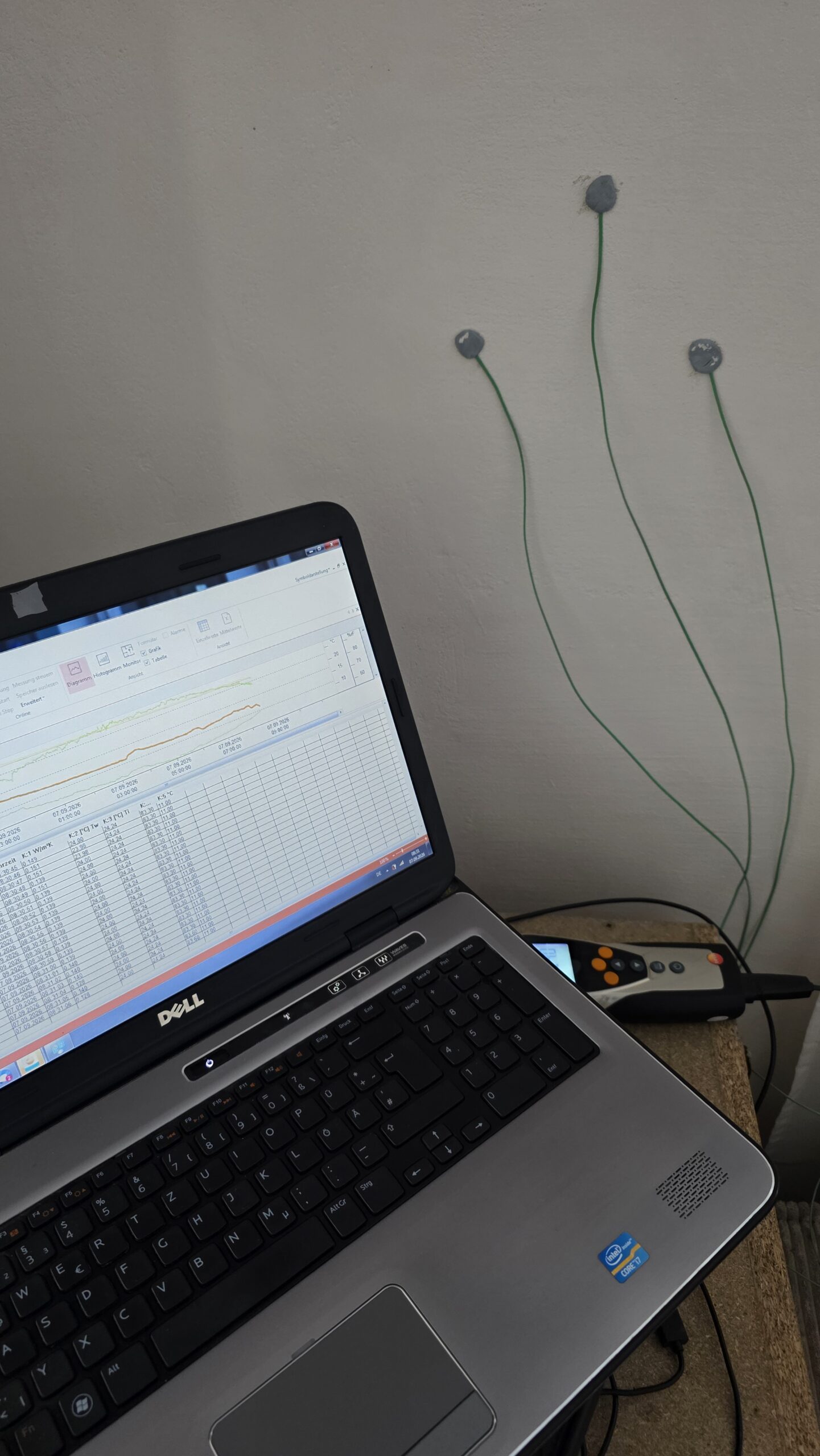
- 0.140
- W/(m²K) · average over the stable measurement window
- 11:57 h
- continuous measurement duration
- 42,978
- valid data points
- ≈ 0.00012
- W/(m·K) · equivalent technical comparison value
What was measured?
The measurement was taken on an actual exterior wall coated with PScoat. The wall build-up comprises historic solid brick, render layers, and the exterior PScoat coating.
The coating was around 0.5 mm thick. Basic B and PSC Build were used, in the 2024 formulation.
Over the stable window from 01:15 to 03:15, the measured U-value averaged around 0.140 W/(m²K).
Technical comparison value
From U-value to equivalent thermal conductivity
R = d / λ
From the measured additional thermal resistance, an equivalent comparison value can be derived for the coating thickness investigated.
- Example calculation at U = 0.20 W/(m²K)
- Rtotal = 5.00 m²K/W
- Rcoating ≈ 4.375 m²K/W
- λeq ≈ 0.000114 W/(m·K)
On this website we use the technical comparison value λ ≈ 0.00012 W/(m·K). The example calculation lies within the same order of magnitude.
Important: the lambda value stated here is the equivalent thermal system performance under CE marking, derived from the measured behaviour of the building element for this build-up and film thickness.
Real building
What actually happens on a real wall?
The thermal image shows very vividly how a building element’s surface temperature changes under comparable conditions.
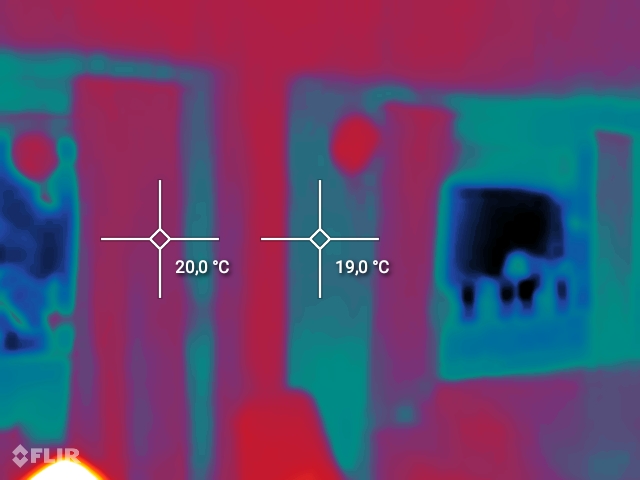
Outside temperature around 0 °C, room temperature around 20 °C. The thermography shows the change in interior surface temperature.
The thermal images make the effect visible.
- 12 → 19 °C
- Wall surface
Example measurement on a historic wall under comparable interior and exterior conditions. - ≈ 40,000 → <15,000
- kWh/year
Documented example figure for a building from the late 19th century. - 36 °C
- Flow temperature
Further comparative measurement on a historic building under a constant heating flow temperature.
Controlled test set-up
Not just measured on the building.
In a controlled test set-up, a multi-layer wall build-up was compared under defined temperature conditions.
| Build-up | Energy / 24 h | Change vs. reference |
|---|---|---|
| Reference | 6.58 kWh | — |
| PSC | 4.38 kWh | −33.4 % |
| 100 mm polystyrene | 4.48 kWh | −31.9 % |
| PSC + facade coating | 4.08 kWh | −38.0 % |
Measured in a controlled test set-up and confirmed in practice by hundreds of satisfied private customers, global corporations and the military. We provide a U-value guarantee on every package variant.
Scientifically measured
What the measurements show.
The measurements show
- a measurable change in thermal resistance
- reduced energy demand, measured in the test set-up and confirmed in practice by hundreds of satisfied private customers, global corporations and the military
- altered cooling behaviour
- clear changes in surface temperatures
- thermal effects under controlled and real-world conditions
Frequently asked questions
The technical questions.
Is PScoat simply an “insulating paint”?
No. PScoat is designed as a thermally active functional coating. Its thermal effect is not described solely by the thickness of a homogeneous insulation layer.
How can a layer of around 0.5 mm have a thermal effect?
Film thickness alone does not fully describe the effect. What matters is the thermal behaviour of the entire construction under the relevant boundary conditions.
What does λ ≈ 0.00012 W/(m·K) mean?
This value is the equivalent technical comparison figure that we derive from the measured behaviour of the building element and the tested coating thickness, and state in line with CE marking.
Can PScoat be factored into a U-value calculation?
The thermal behaviour can be considered via the additional thermal resistance of the system investigated.
Why do real U-value measurements matter?
Because they capture the actual thermal behaviour of a completed building element. This allows theoretical assessments to be checked against real measurement data.
Technical documentation
Want to go deeper? Here’s the data.
Measurements are only genuinely meaningful when the underlying data can be checked.
You don’t have to take our word for it.
Look at the measurements, check the data, and form your own judgement.
So what actually is PScoat?
PScoat is not an ordinary wall paint, but a thermally active functional coating. Its thermal effect does not come from the thickness of a classic, homogeneous insulation layer alone.
With PScoat, thermal conduction, thermal radiation and surface heat transfer all play a part together. That’s why the effect cannot sensibly be judged simply by comparing “0.5 mm of coating against 100 mm of insulation material”. What matters is the resulting thermal resistance of the whole building element under defined boundary conditions.
The effect has been investigated both in controlled test set-ups and on actual completed building elements. We publish test set-ups, measurement curves and measurement data above on this page and in the test report.
How can such a thin layer have a thermal effect?
Film thickness alone does not fully describe PScoat’s thermal effect.
With a classic homogeneous insulation board, thermal resistance is largely described by film thickness and thermal conductivity. With a thermally active coating, radiative effects and heat transfer at the interfaces can also be relevant.
That’s why, with PScoat, we look not just at a single material parameter but at the measurable thermal behaviour of the coated building element.
What does the lambda value mean for PScoat?
Lambda value and equivalent thermal conductivity
To calculate a multi-layer wall build-up, every thermally relevant component is accounted for via its thermal resistance. For a homogeneous layer, R = d / λ applies.
For PScoat, an equivalent lambda value for the coating thickness investigated can be derived from the measured additional thermal resistance of the coated wall.
Across the investigated thickness range of roughly 0.3 to 1.5 mm, the comparison studies show an approximately linear relationship between film thickness and additional thermal resistance.
For the build-ups investigated, this results in an equivalent technical comparison value on the order of λ ≈ 0.00012 W/(m·K). This value serves to translate the measured thermal effect into a conventional calculation model for multi-layer building elements.
Frequently asked technical questions about PScoat
Is PScoat an insulating paint?
No. PScoat is used as a thermally active functional coating. Its thermal effect is not described solely via a classic homogeneous insulation layer, but via the thermal behaviour of the coated building element.
How can 0.5 mm of PScoat insulate at all?
The effect cannot be judged from film thickness alone. Besides thermal conduction, heat transfer and radiative processes are also relevant in a coating. What matters, therefore, is the measurable thermal resistance of the whole building element.
What lambda value does PScoat have?
For the systems investigated, an equivalent lambda value on the order of 0.00012 W/(m·K) can be derived from the measured additional thermal resistance. This value describes the translation of the measured system behaviour into a conventional calculation model.
Can PScoat be factored into a U-value calculation?
Yes. For a specific wall build-up, the coating’s additional thermal resistance can be taken into account and used to calculate a U-value for the whole building element.
Is the lambda value the same at every film thickness?
Across the investigated range of roughly 0.3 to 1.5 mm, the studies show an approximately linear relationship between film thickness and additional thermal resistance. At greater film thicknesses, this linearity decreases.
Are there independent studies?
Yes. Alongside our own measurements, studies from external test and research institutions exist. We also publish real building-element measurements with a documented test set-up.
Why do you show real U-value measurements?
Because a system’s effect shouldn’t only be described theoretically. Measurements on actual completed building elements show what thermal behaviour was genuinely achieved under the documented boundary conditions.
What actually happens on the building?
PScoat’s thermal effect cannot only be described theoretically. It has also been investigated on actual completed buildings.
On a house built in 1900, interior surface temperatures of the exterior wall were measured before and after coating, under comparable conditions. Outside temperature: approx. 0 °C, room temperature: approx. 20 °C. Before: 12.9 °C wall surface; after: 19.0 °C wall surface.
Full documentation and further measurements are available in the test report above on this page.